
What pulls pilots across a continent to a town of a few thousand people? For the free-flight crowd, the answer is Mount 7. This launch above Golden, in the Columbia Valley of southeastern British Columbia, has fed long cross-country flights for decades.
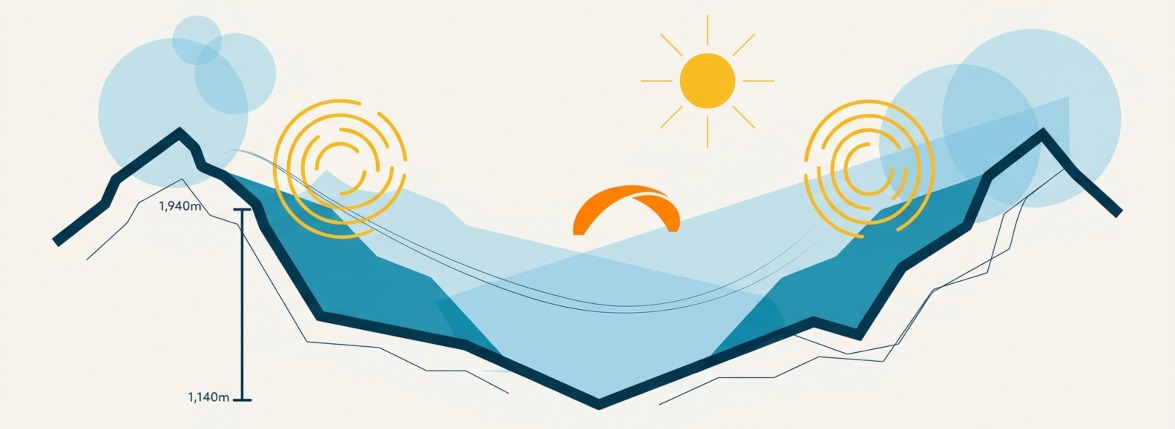
1,940 m
Launch elevation
1,140 m
Vertical to valley
100 km+
Common XC flight
Jul to Aug
Peak XC window
Three things make the valley work for cross-country flying: a long, roughly north-to-south corridor, high terrain on both flanks, and a summer climate that produces dependable convection. Warm afternoons over sun-facing slopes throw off strong thermals, and the valley itself acts as a highway that pilots can follow for tens of kilometres.
Golden hosted the Canadian Paragliding and Hang-Gliding Nationals in 2011, and the town has stayed a fixture on the North American calendar ever since. Its flagship event, the Willi XC Challenge, runs each year across late July and early August. Golden paragliding and hang gliding both share the same launches, so wing choice usually comes down to conditions and personal preference rather than the site itself.
The main launch, known as the Lookout, sits high on Mount 7 above town. An on-launch weather station reports an elevation near 1,940 metres, while the valley floor around Golden sits close to 800 metres. That vertical gives pilots room to climb, link thermals, and push down the valley.
Flights past 100 kilometres are well documented here, most often running south toward Invermere and the upper Columbia. One widely reported personal best in 2018 covered roughly 110 kilometres from Mount 7 to Invermere. Climbs of about 1,000 feet per minute are ordinary on a working day, and stronger cores turn up regularly through midsummer.
Mount 7 has two launches at different heights, and which one flies depends as much on the season as on the wing you bring.
The Lookout is the primary launch and the one most visiting pilots use. Vehicle access depends on the forestry road, which is often blocked by snow into the last week of May. Once the road clears, it stays usable through the season.
Lower on the mountain, a smaller launch opens to vehicles earlier in the year, before the upper road melts out. It is tight and steep, favours hang gliders, and takes only one glider on setup at a time. Paragliders meet more ground snags and trees on either side, so many wait for the Lookout to come in.
The main landing area lies in Nicholson, a small community about five minutes south of Golden on the west side of Highway 95, across the Columbia River. The field is private property, and both its name and its access rules have changed over the years. Confirm the current owner’s requirements before you fly, since landing there has at times called for a signed waiver and a helmet sticker.

A gravel area near Reflection Lake, at the foot of the Mount 7 access road, works as an occasional alternate in light south or southwest winds. It is small, and pilots should treat it as a backup rather than a plan.
The season generally runs from late May to late October. Early on it can be strong and unstable; midsummer brings the most dependable cross-country weather; autumn settles into gentler, lower flights close to the mountain.
Period | Character | What to expect |
|---|---|---|
Late May to mid-June | Strong, unstable | High lapse rates, cold at altitude, frequent overdevelopment by midday |
Mid-June to mid-July | Improving | Often wet early, then patterns settle toward mid-July |
Mid-July to mid-August | Peak cross-country | Best window for long flights; plan for turbulence |
Late August to October | Winding down | Lower climbs, mostly local flying around Mount 7 |
Golden is an afternoon, thermal, and cross-country site. On summer afternoons it earns respect and is best treated as an advanced site until the air softens toward evening. Newer pilots can still enjoy it by flying mornings and glass-off, when the air runs calmer.
Most cross-country flights run south. The single valley highway keeps retrieval simple, and hitch-hiking back is a long-standing local habit when nobody has arranged a driver. Landing options to the south are reasonable, though a few fields carry restrictions that locals can explain on the ground. Heading north is harder: route finding, landing choices, and self-rescue all get more serious, and the terrain gives back less if a flight goes wrong.
Insurance is mandatory to fly the site. For Canadian pilots that means full membership with the Hang Gliding and Paragliding Association of Canada (HPAC), which carries the liability cover the site requires. Visitors from outside Canada can buy a temporary HPAC/ACVL membership that supplies the same insurance for a short stay.
Pilot | Requirement | Where to confirm |
|---|---|---|
Canadian residents | Full HPAC membership | hpac.ca |
International visitors | Temporary HPAC/ACVL membership | hpac.ca |
Everyone | Read and sign any LZ waiver on arrival | Current LZ owner |
Check HPAC directly for current pricing, because membership fees and temporary-visitor terms shift from season to season.
This is real backcountry flying. Away from the valley floor the ground is rugged, forested, and remote. Cell coverage runs patchy and radio can be blocked by terrain. An outlanding that looks like a short stroll from the air can turn into a long, punishing hike, so carry what you need to stay safe and self-sufficient.
Trees are a genuine hazard here, and a tree landing over rough ground can be dangerous. Know the recognised drill for staying in the harness, protecting yourself, and calling for help instead of climbing down alone. A reserve, a hook knife, warm layers, and a way to signal all make sense on any flight that leaves the immediate valley.
A note on rescue: help in the BC backcountry can be slow and costly, and local pilots have historically pooled money into a contingency fund toward helicopter charges. Carry your own coverage and a self-rescue plan regardless of what others arrange.
Visitors who are not rated pilots can still get into the air through tandem flights with local operators. Instruction and tandem paragliding companies work the Golden area seasonally, and availability shifts year to year, so booking ahead pays off.
For equipment, the nearest full-service shop has long sat in the Calgary area, roughly three hours east, stocking hang gliding and paragliding gear and handling repairs. Pilots who travel to fly BC often pair Golden with other Rockies and interior sites within a few hours’ drive.
The correct term is hang gliding. Hand gliding is a common misspelling of the same sport, where the pilot hangs beneath a rigid wing in a prone harness. Golden supports both hang gliding and paragliding from the same launches.
Hang gliding and paragliding are both free-flight sports launched on foot from a hill or mountain, with no boat or tow once airborne. Parasailing is a different activity: a passenger rides behind a boat under a canopy with little control. People sometimes search hang gliding or parasailing together, but only the first two apply to Mount 7.
Mid-July to mid-August is the strongest window for cross-country flying. Pilots who prefer calmer air tend to pick mornings and evenings across the rest of the season.
Yes. You need pilot insurance to fly the site, which for Canadians means HPAC membership and for visitors means a temporary HPAC/ACVL membership. See the requirements above.
Most drive or arrange a shuttle up the forestry road to the Lookout. After a cross-country flight, retrieval usually depends on a driver or on hitch-hiking along the valley highway.
This is an independent, informational resource about free flight in Golden, Canada. It is not affiliated with any club, landing-zone owner, event, or commercial operator, and it does not manage or control access to any launch or landing area. The domain previously hosted free-flight material for this region. The text here is original and offered for general orientation only. Site access, landing rules, pricing, and membership terms change often, so confirm current details with the official sources below before you fly.